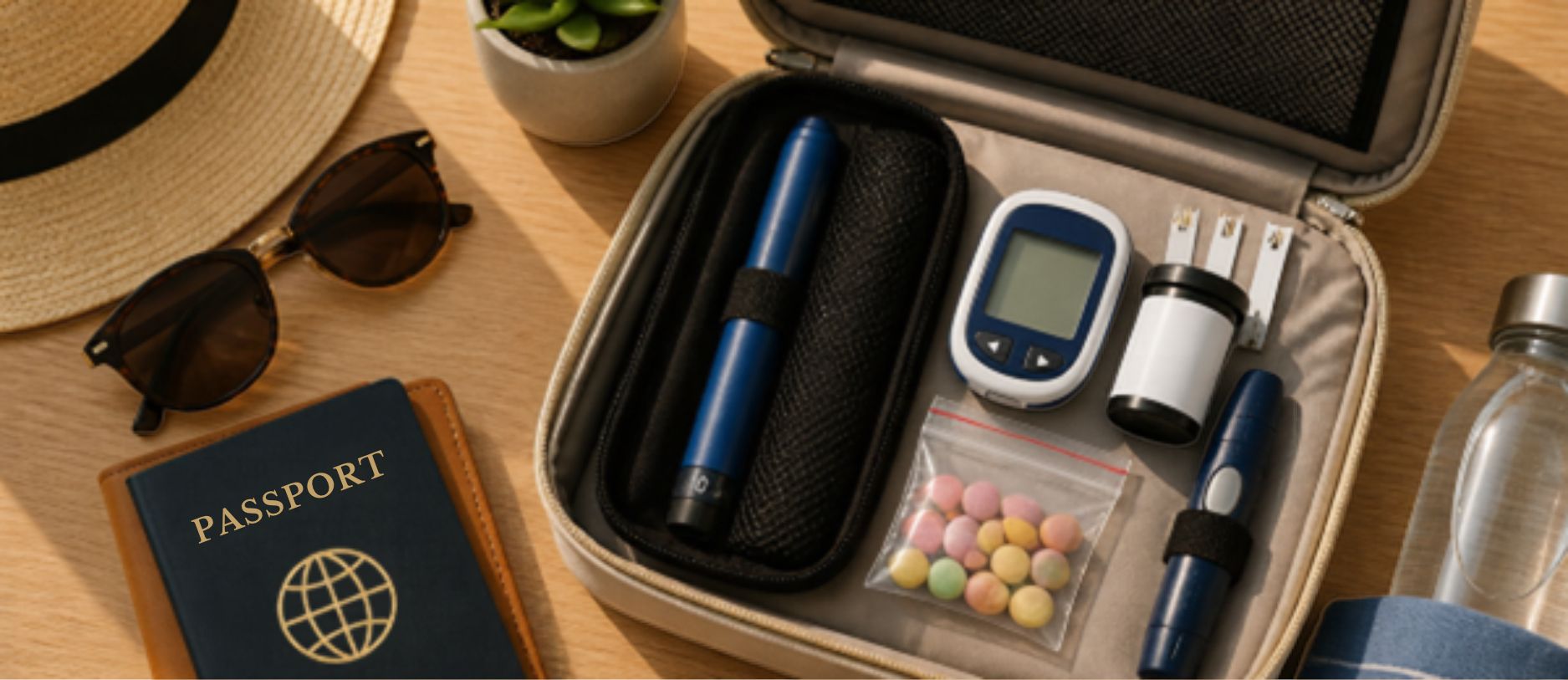
Travel with diabetes is absolutely doable, millions of people do it constantly, but it does take a bit more planning than tossing a bag together the night before. Most of the stress around it comes from a handful of predictable snags: running out of supplies, a device getting damaged in transit, or security screening taking longer than expected. Here's a complete checklist to get ahead of all of it.
Before you go
- Get a doctor's letter. A brief letter confirming your diagnosis and listing your supplies (insulin, pump, CGM, syringes, etc.) can smooth over airport security and customs questions, especially internationally.
- Pack more supplies than you think you'll need. A common rule of thumb is to pack at least double your expected needs, insulin, test strips, pump or CGM supplies, oral medication, and split them across two bags so a single lost or damaged bag doesn't leave you without everything.
- Check medication names at your destination. The same medication can be sold under a different brand name in another country. Knowing the generic name, not just the brand you buy at home, matters if you need to source more while away.
- Confirm your travel insurance covers pre-existing conditions. Diabetes often needs to be explicitly declared on travel insurance, and a policy that doesn't cover it can leave you exposed for exactly the kind of care you're most likely to need.
- Talk to your doctor about time zones well before you leave, if your trip crosses several zones. Adjusting insulin or medication timing around a long-haul flight is something to plan individually with your care team in advance, not something to work out mid-flight.
Packing it right
- Keep all insulin, pump supplies, and medication in your carry-on, never in checked luggage. Aircraft cargo holds can reach temperature extremes that damage insulin, and checked bags can be lost or delayed, which is a much bigger problem for medication than for clothes.
- Protect insulin from extreme heat and cold. A dedicated cooling pouch helps in hot climates. Insulin should never be allowed to freeze either, so be mindful of it sitting near an aircraft window or air vent on a cold route.
- Bring your documentation. Doctor's letter, prescription copies, and a medical ID bracelet or card are all worth having on hand, not just packed away in a bag you won't open until you land.
- Pack a low-tech backup, even if you don't normally need one. If you use a pump, bring spare pens or syringes in case of device failure. If you use a CGM, bring a finger-stick kit as backup. The goal is never being fully dependent on a single device with no fallback mid-trip.
At airport security
- Declare your supplies at screening. Most countries allow a medical exemption for insulin and related supplies beyond standard liquid limits, but policies and procedures vary by country and airport, so check the specific guidance for your departure and connecting airports before you travel rather than assuming.
- Allow extra time. Declaring medical supplies can mean additional screening, so build in buffer time rather than cutting your airport arrival close.
- Check scanner guidance for your specific device. Some pump and CGM manufacturers publish guidance about airport security scanners and metal detectors for their specific devices. It's worth checking your device's manual or manufacturer site before you fly, and requesting alternative screening at the checkpoint if needed.
During the trip
- Expect your routine to shift. New food, more walking than usual, disrupted sleep, and time zone changes can all affect blood sugar in ways that are hard to predict from home. This is exactly the kind of stretch where checking more often than usual, rather than less, pays off.
- Be extra mindful with unfamiliar food. Carb-counting a dish you've never seen before is harder than one you know well, and nutrition labeling conventions differ by country too. Give yourself grace for a less precise estimate while traveling.
- Watch for the exercise effect of a more active trip. A day of sightseeing on foot can function like a workout, sometimes lowering blood sugar more than a normal day at home would, so it's worth keeping fast-acting carbohydrate on hand even on days that don't feel like "exercise days."
Plan for the unexpected
- Research your destination's nearest pharmacy and hospital before you need them, not after.
- Carry a translation card or learn the phrase for "I have diabetes, I need sugar" in the local language if you're traveling somewhere your language isn't widely spoken.
- Keep your care team's contact details accessible, along with any telehealth option they offer, in case you need guidance while away.
Keeping track without the usual routine
Travel is exactly when logging tends to slip, which makes the trip harder to make sense of afterward, and harder to discuss with your care team when something didn't go as expected. GlyBeat keeps your meals, activity, and glucose trends (via Apple Health) together in one place even when your schedule is anything but normal, so the full picture is still there when you're back, rather than a gap in your history for the week you were away. Zen is also there for quick questions on the go, like understanding an unfamiliar food or making sense of a pattern that showed up mid-trip.